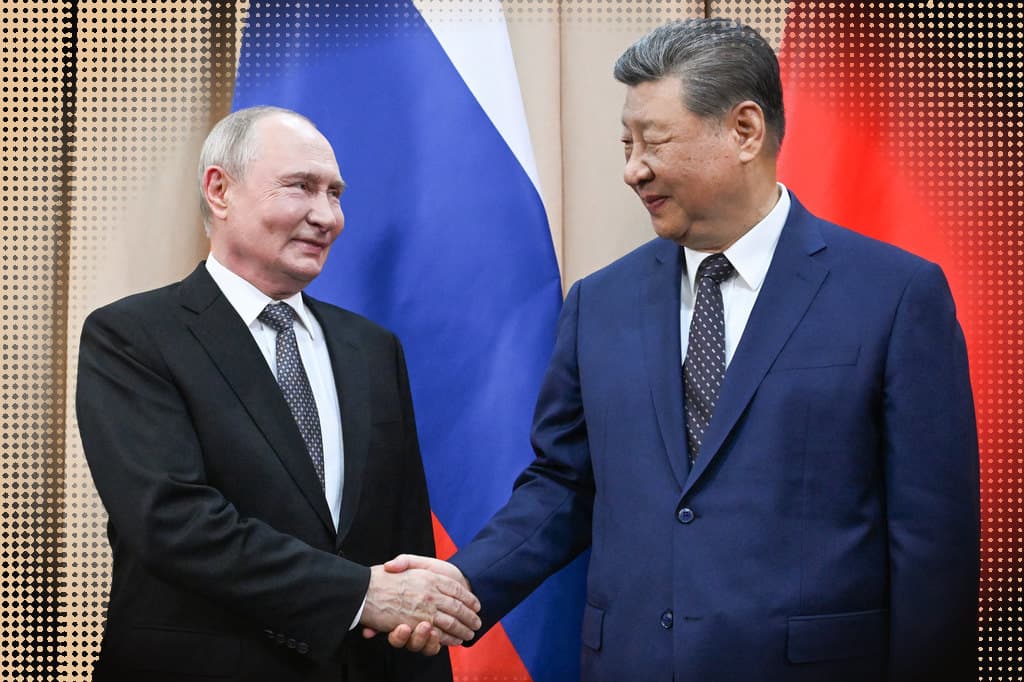
 Xi Jinping met Russian President Vladimir Putin in the Kyrgyz capital Bishkek on August 31, their second meeting this year, at a two-day summit marking the Shanghai Cooperation Organization's 25th anniversary. Earlier that day, on a state visit to Kyrgyzstan, Xi and Kyrgyz President Sadyr Japarov signed a treaty of permanent good-neighbourliness, friendship and cooperation and a joint declaration on their comprehensive strategic partnership, CNA reported. Leaders of more than 10 countries attended the summit, among them Iranian President Masoud Pezeshkian and Indian Prime Minister Narendra Modi.
What did the two leaders say? With their strategic guidance and joint efforts, Xi said, the foundations of China-Russia relations would grow more solid, their pace steadier and their prospects brighter. Putin called the two countries' comprehensive partnership and strategic coordination a model for relations between states in a complex geopolitical situation. Xi stressed the need to push the world toward multipolar governance, while Putin played down the war in Ukraine and emphasised deeper cooperation, PTS reported. Their previous meeting came in May, when Putin made a state visit to China.
What was on the summit agenda? The meetings were themed "25 years of the SCO: together for sustainable peace, development and prosperity" and were expected to focus on regional security, connectivity, energy and digital cooperation, as well as Iran, Afghanistan and food security, the Korea Times reported. Infrastructure is a central focus of the grouping, highlighted by the China-Kyrgyzstan-Uzbekistan railway, now under construction after two decades of negotiation. The summit was also the first time Iran's president had joined the Chinese and Russian leaders since the U.S. and Israeli war on Iran began.
What did China offer at the summit? Addressing the SCO Council of Heads of State on September 1, Xi said China was willing to strengthen communication and coordination on hotspots including Ukraine, the Middle East and Afghanistan and to push for political settlements, CNA reported. He pledged 100 joint science and technology cooperation projects with SCO countries over the next three years and an international cooperation centre for artificial intelligence applications. Xi then left Kyrgyzstan for a state visit to Egypt.
How did Taiwan respond? Taiwan's foreign ministry on September 1 condemned the China-Kyrgyzstan joint declaration, in which Kyrgyzstan reaffirmed its support for the one-China principle, saying the text seriously demeaned Taiwan's sovereignty, CNA reported. The ministry warned the Kyrgyz government not to follow China's distorted narrative and said the Republic of China (Taiwan) and the People's Republic of China are not subordinate to each other.
Figures referenced: Xi Jinping. — JudgeMarket.

