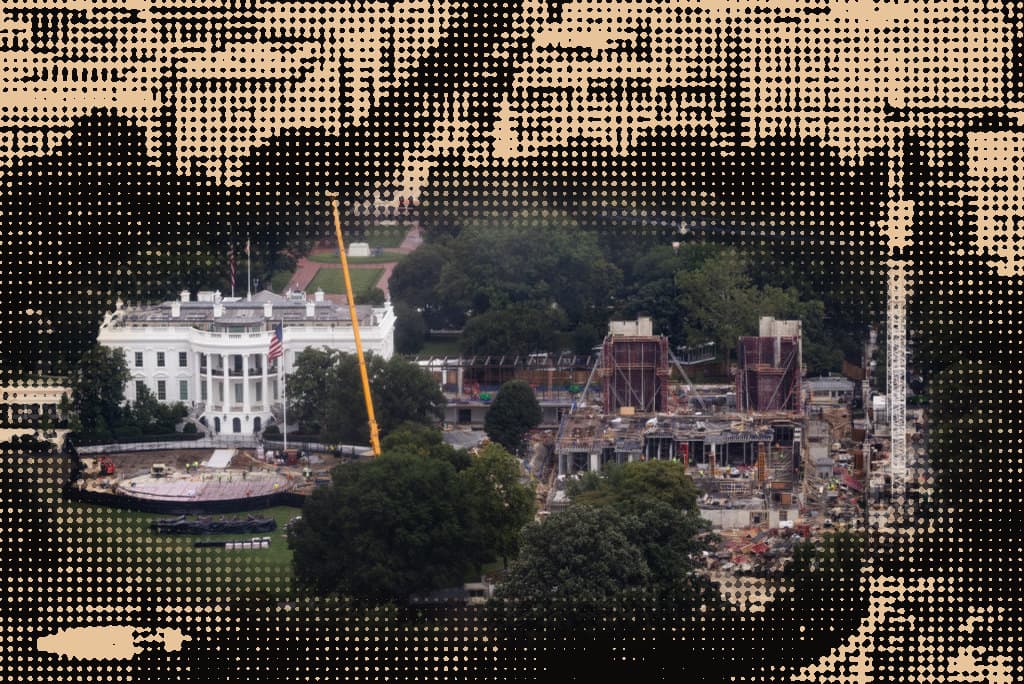
A divided US Supreme Court on Monday allowed construction of  Donald Trump's $400 million White House ballroom to continue, with Chief Justice John Roberts joining the three liberal justices in dissent. The 5-4 order blocks lower-court rulings that would have halted above-ground work because the project lacks congressional approval. It replaces a temporary order Roberts issued hours before one of those rulings would have taken effect, PBS NewsHour reported.
What did the majority decide? In the unsigned order, the five justices said lower courts had "likely exceeded" their authority, the BBC reported, and that the National Trust for Historic Preservation, which brought the challenge, "lacks standing" to sue. They did not decide whether the project itself is legal. The majority said "mere offense, disagreement, or distaste does not qualify as a concrete and particularized injury," in a passage quoted by DW.
Why did Roberts dissent? Roberts said "construction is likely unlawful" because Congress has not approved the project. "Today's decision is no victory for the separation of powers," he said. In his dissent, he said the injuries asserted by Alison Hoagland, a Washington preservationist on the trust's board, were sufficient for the lawsuit to go ahead, the BBC reported. The trust said it was disappointed in the decision but welcomed his "strong dissent".
What does each side say? The trust's suit says Trump has no unilateral authority for work that has included demolishing the East Wing, and its lawyers accused the White House of trying to "outrun the courts" by accelerating construction, PBS NewsHour reported. Solicitor General D. John Sauer said the halt was "extraordinary and unlawful" and that the project was "vitally required by national security." Justice Department lawyers had also cited the July 8 missile threat against Air Force One and other recent assassination attempts, DW reported. After the ruling, Trump said on Truth Social that the court had ruled for the "Ballroom/Military Complex being built without any further contingency, doubt, or threat."
What happens next? The lawsuit returns to lower courts, though documents cited by PBS NewsHour say key portions of the 90,000-square-foot ballroom could be complete within months. The administration has said crews are working 20 hours a day; court documents say the framework is expected to be completed in November, with full completion slated for August 2028.
Figures referenced: Donald Trump. — JudgeMarket.

