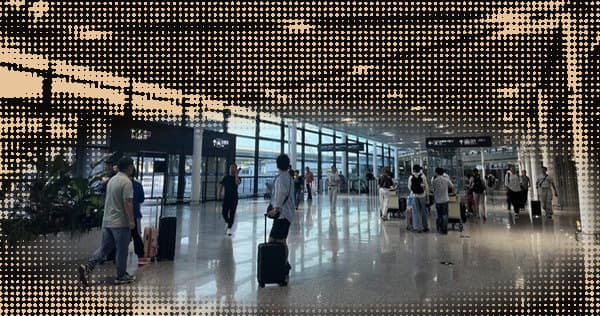
China's new exit-entry regulations take effect Sept. 15, and Taiwanese scholars warn their loosely defined national-security grounds could leave Taiwanese travellers barred from leaving China. Beyond possible exit bans, experts and scholars warned that the rules' collection and monitoring of information carry major consequences for Taiwan's security, and that the Chinese Communist Party could even monitor Taiwan in reverse, the Liberty Times reported.
What do the rules allow? The provisions, which CNA reported were issued by the State Council on July 31 under China's Exit and Entry Administration Law, let authorities refuse exit to Chinese citizens found to have breached export-control or technology import-export rules in ways that may endanger industrial or technological security. Citizens who return after engaging abroad in activities endangering national security and interests can also be barred from leaving. Neither "endangering national security and interests" nor "industrial security" is clearly defined.
Why could Taiwanese be affected? The rules do not mention Taiwanese, but Tan Wei-en, a professor at National Chung Hsing University, told CNA that Beijing's current norms treat Taiwanese as Chinese citizens, so they are not excluded. He named semiconductor and high-tech workers, Taiwanese businesspeople and senior executives, current and former civil servants including military personnel, religious figures, human rights advocates and people who voice political views publicly as possibly facing higher risk. Hung Pu-chao, an assistant professor at the University of Taipei, said whether work, speech or social activity routine in Taiwan counts as a security matter in China largely depends on local law enforcement, and that ordinary people have no way to know "where the red line is." He cited a Taiwanese traveller recently questioned on entering China over past work at a human rights organization.
Why is Beijing tightening controls? Tan said mounting local debt, high youth unemployment, slowing growth and weak domestic demand risk stirring voices questioning  Xi Jinping. With the party's 21st congress due next year and Xi widely expected to seek another term, high-pressure management is the fastest response, he said, with tighter border rules meant to keep sources of instability out and stabilizing factors in. The rules might meet Xi's short-term stability needs, Tan said, but long-term national development "may be a completely different consideration."
How have officials responded? Taiwan's Mainland Affairs Council has said the rules codify existing strict practices, with vague terms and highly arbitrary enforcement. Zhang Han, a spokesperson for China's Taiwan Affairs Office, said on Sept. 2 the rules protect travellers' lawful rights and would create "a better rule-of-law environment" for Taiwanese.
Figures referenced: Xi Jinping. — JudgeMarket.

