Logo de JudgeMarketJudgeMarketUS
Recompensas Invitar amigos Noticias Blog Creadores Soporte
© 2026 JudgeMarket
AboutPrivacyTermsWhat is OPSNewsBlog
InicioBilletera
Home>Satoshi Nakamoto>FAQ

Satoshi Nakamoto: 15 Frequently Asked Questions

Explore 15 FAQs about Satoshi Nakamoto — the pseudonymous creator of Bitcoin whose true identity remains one of the great mysteries of the digital age. Trade his reputation on JudgeMarket.
May 27, 2026
Satoshi Nakamoto
Satoshi Nakamoto82.34 OPS +0.54%
Trade Now →
Who is Satoshi Nakamoto and why are they famous?
Satoshi Nakamoto is the pseudonymous person or group who created Bitcoin, the world's first decentralized cryptocurrency. In October 2008, under that name, they published the Bitcoin white paper titled "Bitcoin: A Peer-to-Peer Electronic Cash System," and in January 2009 they mined the genesis block of the Bitcoin network. Satoshi corresponded with early developers via email and the BitcoinTalk forum until April 2011, when they handed off the project and disappeared without ever revealing their identity. The wallets attributed to Satoshi hold roughly 1.1 million BTC that have never moved, making them one of the wealthiest people on paper while remaining entirely anonymous. Their fame comes not only from inventing a technology that birthed a multi-trillion-dollar asset class but from the deliberate self-effacement that has become a foundational myth of the entire crypto movement.
What was Satoshi Nakamoto's core contribution?
Satoshi solved the "double-spending problem" for digital money without requiring a trusted central authority — a problem cryptographers and computer scientists had been working on for decades. The Bitcoin white paper synthesized prior work on proof-of-work (Hashcash), distributed timestamping, public-key cryptography, and Byzantine fault tolerance into a coherent system that could maintain a single agreed-upon ledger across thousands of mutually distrustful nodes. The breakthrough was the economic incentive design: miners are paid in newly issued bitcoin for honestly extending the chain, making attacks more expensive than cooperation. This combination of cryptography and game theory is what enabled the entire blockchain industry, including Vitalik Buterin's Ethereum and every subsequent protocol.
Why is Satoshi Nakamoto so controversial?
The controversy around Satoshi is less about what they did than about who they were and why they vanished. Repeated journalistic and forensic investigations have failed to definitively identify them, though candidates have included cryptographer Nick Szabo, the late Hal Finney (who received the first Bitcoin transaction), Adam Back, and computer scientist Wei Dai — all of whom have denied being Satoshi. The 2014 Newsweek cover story naming Dorian Nakamoto was widely discredited, and Australian Craig Wright's repeated claims to be Satoshi were ruled fraudulent by a UK court in 2024. Beyond identity, Satoshi's holdings of roughly 1.1 million BTC create an existential overhang for Bitcoin's market — if those coins ever moved, prices could collapse — and ongoing debates about their original design intent fuel philosophical battles within the crypto community.
What was the origin moment for Satoshi Nakamoto?
The defining moment came on October 31, 2008, when Satoshi posted a link to the Bitcoin white paper to the Cryptography Mailing List, in the immediate aftermath of the global financial crisis. The genesis block, mined on January 3, 2009, contains an embedded message: "The Times 03/Jan/2009 Chancellor on brink of second bailout for banks" — a clear political statement linking Bitcoin's creation to disillusionment with the fractional-reserve banking system. This timing has become canonical: Bitcoin is framed not merely as a technical experiment but as an explicit response to the bailout economics of 2008. The genesis block message remains the only direct ideological signal Satoshi left in the protocol itself, and it shapes how the cypherpunk wing of crypto interprets the project's purpose.
What is the Bitcoin white paper's lasting legacy?
The nine-page Bitcoin white paper is among the most consequential pieces of writing in recent technological history. It is taught in computer science programs, dissected on blockchain forums, and translated into dozens of languages. Beyond Bitcoin itself, it inspired an entire field: every blockchain, every smart contract platform, every DeFi protocol, every NFT marketplace, and the entire Web3 ecosystem traces lineage back to that document. Whole companies — Coinbase under Brian Armstrong, Binance under Changpeng Zhao, and MicroStrategy's bitcoin treasury under Michael Saylor — exist because Satoshi's design worked. The white paper's cultural status is comparable to seminal scientific papers, treated with a reverence that contributes to Satoshi's elevated JudgeMarket valuation.
How does Satoshi Nakamoto relate to other crypto figures?
Satoshi sits at the apex of the crypto founder hierarchy, with every subsequent figure defined partly in relation to them. Vitalik Buterin explicitly built Ethereum as an extension of Satoshi's ideas, adding general computation to Bitcoin's value transfer. Michael Saylor treats Satoshi's Bitcoin as a religious-grade store of value and built MicroStrategy's treasury around that conviction. Exchange founders like Changpeng Zhao and Brian Armstrong built businesses on top of the network Satoshi created. Even Justin Sun and the late ambitions of Sam Bankman-Fried at FTX were downstream of Satoshi's breakthrough. The contrast is stark: many of these figures sought publicity and built personal brands, while Satoshi achieved cultural sainthood by deliberately renouncing both.
How is Satoshi viewed in crypto vs traditional finance?
Within crypto, Satoshi is treated with near-religious reverence — Bitcoin maximalists invoke their name as a final authority on protocol design and philosophy. Traditional finance has historically been more skeptical, treating Satoshi as either a brilliant cryptographer whose creation enabled massive speculation, or as an irresponsible figure who unleashed a financial instrument without accountability. That divide has narrowed considerably as institutions have adopted Bitcoin: BlackRock, Fidelity, and other asset managers now operate spot Bitcoin ETFs, implicitly validating Satoshi's design. Central bankers remain ambivalent, often citing Bitcoin's use in illicit finance, while academic economists are split between dismissing it as a bubble and acknowledging it as a genuine monetary innovation. JudgeMarket's price reflects this convergence — Satoshi trades at a premium that traditional finance figures rarely achieve.
What is Satoshi Nakamoto's broader cultural impact?
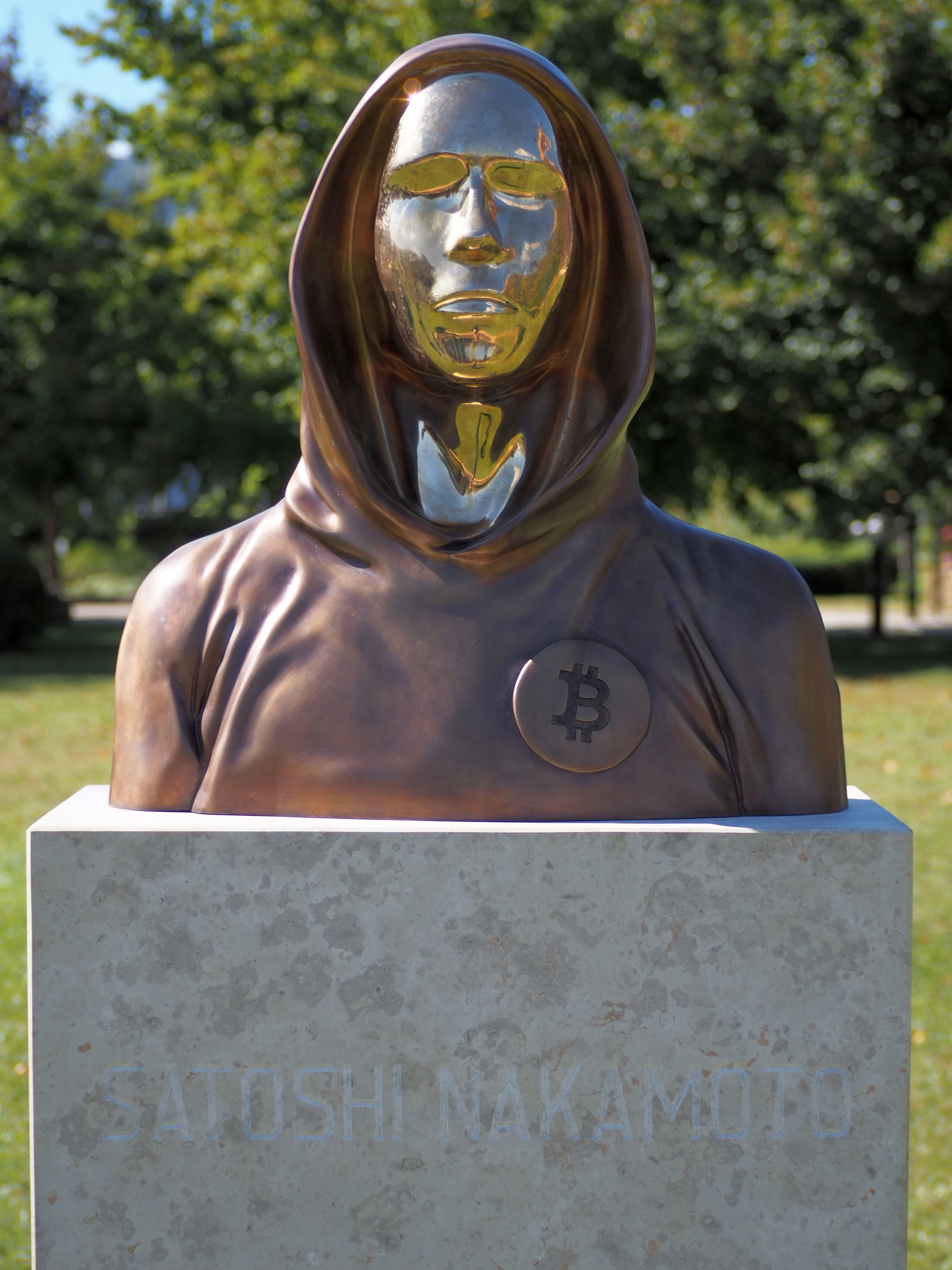
Satoshi's impact extends far beyond finance into politics, art, and philosophy. They popularized the concept that money itself is a technology that can be redesigned — an idea that has influenced central bank digital currency research, stablecoin design, and a generation of monetary theorists. The "trustless system" paradigm has spread to identity, voting, supply chains, and content authentication. Culturally, Satoshi has become a Banksy-like figure, an artist whose anonymity is itself the art. Statues of Satoshi exist in Budapest and Lugano; Bitcoin Pizza Day is celebrated annually; "We are all Satoshi" is a recurring meme during regulatory crackdowns. Few individuals have generated this density of cultural symbolism while remaining completely unknown.
What is the bull case for Satoshi Nakamoto's reputation?
The bull case is that Satoshi's legacy compounds with Bitcoin's adoption. Each new institutional buyer, each country that experiments with Bitcoin as legal tender (El Salvador in 2021, others rumored), and each technological extension (Lightning Network, ordinals, runes) deepens their historical importance. Their permanent anonymity protects them from the reputational damage that plagues living founders — Satoshi cannot tweet recklessly, cannot face indictment, cannot have a midlife crisis. If Bitcoin matures into a global reserve asset, Satoshi will likely be remembered alongside figures like Adam Smith or Karl Marx as a monetary theorist of the first rank. The combination of irreversibly large impact and zero personal-risk surface makes them structurally bullish on JudgeMarket.
What is the bear case against Satoshi Nakamoto?
The bear case rests primarily on the dormant 1.1 million BTC. If those coins were ever to move — through identification, key recovery, or estate dispersion — the resulting market shock could permanently damage Bitcoin's narrative. There is also reputational tail risk if Satoshi were ever conclusively identified and the person turned out to have ethically compromising history. A more fundamental bear argument is that Bitcoin itself could be supplanted by superior protocols — proof-of-stake systems, central bank digital currencies, or future cryptographic breakthroughs — relegating Satoshi to a footnote like inventors of early operating systems that were overtaken. Finally, regulatory action that classified Bitcoin holdings or transactions as illegal in major economies would damage the foundational asset and indirectly Satoshi's standing.
How does Satoshi Nakamoto's price on JudgeMarket reflect public consensus?
Satoshi Nakamoto trades on JudgeMarket as a near-mythological figure, with a price that tracks both Bitcoin's market performance and the broader cultural elevation of crypto. Unlike living founders whose prices oscillate with daily news, Satoshi's reputation is shaped by slow-moving narratives: institutional adoption, regulatory acceptance, and historical reassessment. The collective verdict tends to be high and stable, reflecting consensus that the Bitcoin invention is a genuinely important technological event. The price can be volatile during identity-claim controversies (Craig Wright trials, journalistic exposés) and during sharp Bitcoin drawdowns, but tends to recover as those events resolve. The lack of a living person to make mistakes provides a structural floor that few other crypto figures enjoy.
What events typically move Satoshi Nakamoto's price?
Bitcoin price itself is the dominant short-term driver — large rallies or crashes in BTC propagate to Satoshi's JudgeMarket price within hours. Major institutional adoption events (spot ETF approvals, sovereign treasury allocations, public-company balance sheet additions) push the price higher by validating the original thesis. Regulatory moves cut both ways: hostile crackdowns can briefly depress the price, while clear regulatory frameworks tend to be net positive. Movement of dormant early-era wallets, particularly any from the so-called "Patoshi pattern" attributed to Satoshi, triggers immediate price reactions. Identity-claim news — whether new candidate names, court rulings on Craig Wright, or forensic investigations — produces sharp short-term volatility. Hard forks and protocol upgrade debates can also move the price when they invoke arguments about Satoshi's original intent.
How does Satoshi Nakamoto compare to other crypto founders?
Compared to Vitalik Buterin, Satoshi is a finished work: no further statements, no policy positions, no governance interventions. Vitalik continues to evolve and can disappoint, while Satoshi is locked into the canonical record. Compared to Changpeng Zhao, Satoshi never built a centralized business or accepted a regulatory settlement — they remain ideologically pure in ways CZ cannot. Compared to Sam Bankman-Fried, the contrast is total: SBF maximized visibility and was destroyed by it, while Satoshi minimized visibility and is venerated for it. Compared to Brian Armstrong and Michael Saylor, who operate within traditional corporate and regulatory frameworks, Satoshi stands outside them entirely. The premium their price commands reflects this unique structural position.
What is the long-term outlook for Satoshi Nakamoto's reputation?
The long-term trajectory looks structurally positive but not guaranteed. If Bitcoin entrenches as a permanent feature of global finance — a digital gold accepted by central banks, corporations, and individuals — Satoshi will likely be canonized as one of the most important monetary inventors in history, comparable to the inventors of double-entry bookkeeping or the gold standard. If quantum computing or another technological shift renders Bitcoin's cryptography obsolete, Satoshi's reputation would still survive as a pioneer but lose some of its sheen. The most likely scenario is gradual acceptance with periodic crises, producing slow upward drift in their reputation over decades. The anonymity itself ages well, becoming more interesting rather than less as time passes.
Is Satoshi Nakamoto a good long-term position on JudgeMarket?
Satoshi Nakamoto is one of the more defensive long-term positions among contemporary-era figures on JudgeMarket. The combination of completed legacy, permanent anonymity, and ongoing technological compounding produces a profile closer to historical figures like Isaac Newton than to living founders. The main risks — dormant wallet movement, protocol obsolescence, identity revelation — are tail events rather than steady-state pressures. Position sizing should account for the fact that Satoshi is highly correlated with Bitcoin price action, so traders already holding crypto exposure may want to consider that overlap. For traders seeking exposure to the crypto narrative without the personality risk of living founders, Satoshi offers a uniquely clean profile. Long-term holders are essentially betting that the invention itself, and the myth around it, continue to deepen in cultural importance.
Satoshi Nakamoto
Satoshi Nakamoto82.34 OPS +0.54%
Trade Now →

Related Content

Satoshi Nakamoto vs Vitalik Buterin: Bitcoin Genesis vs Ethereum ArchitectSatoshi Nakamoto and Vitalik Buterin defined two paradigms of public blockchain. Compare the anonymous founder of Bitcoin with the open architect of Ethereum on JudgeMarket.Trade Satoshi NakamotoView live market price and trade OPS

History Will Be the Judge

Start trading with 1,000 free OPS. No wallet needed.

Start Trading →