شعار JudgeMarketJudgeMarketUS
المكافآت ادعُ الأصدقاء الأخبار المدونة المطورون الدعم
© 2026 JudgeMarket
AboutPrivacyTermsWhat is OPSNewsBlog
الرئيسيةالمحفظة
Home>Jiang Zemin>FAQ

Jiang Zemin: 15 Frequently Asked Questions

Explore 15 FAQs about Jiang Zemin — CCP General Secretary from 1989 to 2002, the leader who steered China through post-Tiananmen recovery, WTO accession, and the Hong Kong handover. Trade his reputation on JudgeMarket.
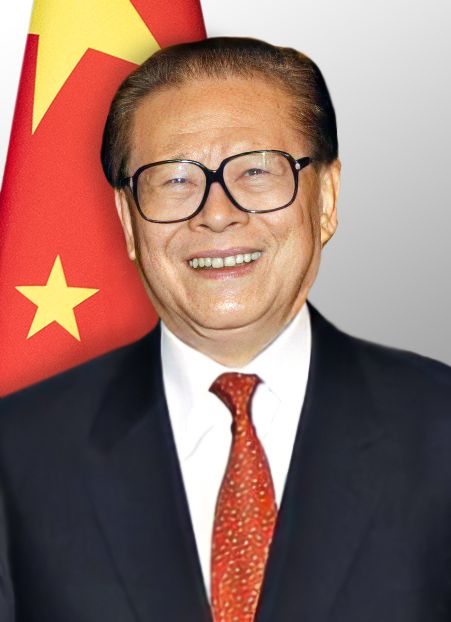
May 27, 2026
Jiang Zemin
Jiang Zemin32.45 OPS +1.41%
Trade Now →
Who is Jiang Zemin and why is he famous?
Jiang Zemin (1926–2022) served as General Secretary of the Chinese Communist Party from 1989 to 2002, President of the People's Republic of China from 1993 to 2003, and Chairman of the Central Military Commission from 1989 to 2004. An electrical engineer trained partly in the Soviet Union, he rose through Shanghai's municipal leadership before being elevated to the top position in the aftermath of the 1989 Tiananmen crisis. His thirteen years in power saw China transition from international pariah after Tiananmen to WTO member and rising global economic power. He oversaw the 1997 Hong Kong handover, deepened the reforms of Deng Xiaoping, and articulated the "Three Represents" theory that brought entrepreneurs into the Communist Party.
What is Jiang Zemin's main political legacy?
Jiang's legacy is the stabilization and acceleration of Deng Xiaoping's reform model. Under his leadership, China weathered post-Tiananmen sanctions, completed the most aggressive state-owned enterprise restructuring since 1949 (with tens of millions of layoffs), joined the World Trade Organization in 2001, and saw GDP roughly triple. He institutionalized the "Three Represents" — opening Party membership to entrepreneurs and professionals — which represented a major ideological reframing of the CCP. He oversaw the smooth return of Hong Kong from British rule in 1997 and Macau from Portuguese rule in 1999. His decision to step down on schedule in 2002 helped institutionalize peaceful leadership transitions, though he retained Military Commission chairmanship for two extra years.
Why is Jiang Zemin controversial?
Jiang's controversy spans multiple dimensions. The crackdown on Falun Gong beginning in 1999 drew sustained international criticism for human rights abuses, including credible allegations of forced organ harvesting. State-owned enterprise restructuring caused massive layoffs and social disruption in northeastern industrial regions. The "Shanghai Gang" — a network of officials with Shanghai connections — became associated with elite wealth accumulation and corruption that Xi Jinping's anti-corruption campaign later targeted. Critics also point to censorship intensification, the Tibet situation, and his role in extending Mao-era political controls into the market era. Supporters credit him with delivering prosperity, navigating Hong Kong's return successfully, and avoiding major conflict with the United States despite multiple crises.
What was Jiang Zemin's early career?
Jiang was born in Yangzhou, Jiangsu province, in 1926, and grew up during the Japanese occupation. His biological father served in a Japanese-collaborationist government, a fact later officially papered over by treating his uncle Jiang Shangqing — a Communist martyr — as his adoptive father. He studied electrical engineering at Shanghai Jiaotong University, joining the CCP in 1946. He spent decades as a technocrat in the machine-building industry, including training stints in the Soviet Union and a posting in Romania. He rose to Minister of Electronics Industry in 1983 and Mayor of Shanghai in 1985. His careful handling of the 1989 Shanghai protests — defusing the situation without bloodshed — caught Deng Xiaoping's attention and led to his elevation to General Secretary after Zhao Ziyang's removal.
How did Jiang Zemin come to power?
Jiang's elevation was a direct consequence of the 1989 Tiananmen crisis. With General Secretary Zhao Ziyang removed for opposing martial law, Party elders led by Deng Xiaoping needed a successor untainted by either the protests or the crackdown decision. Jiang's reputation for stability in Shanghai, combined with his lack of strong factional enemies, made him the compromise choice. He was promoted to General Secretary at the Fourth Plenum in June 1989, just weeks after the Tiananmen crackdown. Deng formally retired in 1992, and Jiang gradually consolidated his own authority through the 1990s, surviving an early period of being viewed as a transitional figure to become a substantive paramount leader in his own right.
How does Jiang Zemin relate to his predecessors and successors?
Jiang governed in the shadow of Deng Xiaoping until Deng's 1997 death, then for the next five years as paramount leader in his own right. He continued and accelerated Deng's economic reforms while preserving political controls. He was succeeded by Hu Jintao in 2002, though he retained Military Commission chairmanship for two additional years — a partial overhang that constrained Hu's early authority. The "Shanghai Gang" faction associated with Jiang remained influential under Hu and into the early Xi Jinping period before being substantially dismantled by Xi's anti-corruption campaign. Jiang's relationship with Xi Jinping was nominally cordial, though many of the institutional norms Jiang helped establish have since been reversed.
How is Jiang Zemin viewed differently across China and the world?
Within China, Jiang became something of a cult figure in his later years, with the "Toad Worship" internet meme treating him as an affectionate, eccentric grandfather figure — a phenomenon many read as implicit comparison with Xi Jinping's more austere style. His passing in November 2022 prompted significant public mourning, with some observers noting the contrast between popular sentiment and the relatively understated official commemoration. Internationally, he was viewed as an unusually personable Chinese leader, fluent in multiple languages and prone to spontaneous gestures including singing in public. In Taiwan, his era saw both the 1995–1996 missile crisis and significant economic integration. In Hong Kong, his role in the handover is remembered, though "one country, two systems" itself is now widely viewed as having failed.
What were the main events of Jiang's tenure?
Major events included the 1992 endorsement of Deng Xiaoping's Southern Tour that consolidated market reforms, the 1995–1996 Taiwan Strait Crisis triggered by US missile testing in response to PRC exercises, the 1997 Hong Kong handover from Britain, the 1999 US bombing of the Chinese embassy in Belgrade during the Kosovo war (which caused major Sino-American tension), the 2001 US-China spy plane incident, China's December 2001 WTO accession, and the launch of the campaign against Falun Gong in 1999. Domestically, the state-owned enterprise restructuring of the late 1990s laid off tens of millions of workers — among the largest workforce dislocations in human history.
What is the bull case for Jiang Zemin's reputation?
Bulls argue Jiang executed perhaps the most consequential economic stewardship of any Chinese leader since Deng Xiaoping, guiding China from post-Tiananmen isolation into the WTO and global manufacturing dominance. They credit him with successfully integrating Hong Kong (initially), navigating multiple US-China crises without conflict, completing the painful state-owned enterprise reforms that Hu Jintao and Xi Jinping inherited as a stable foundation, and modernizing the People's Liberation Army. The Three Represents theory, while ideologically awkward, allowed the CCP to incorporate the entrepreneurial class that has driven Chinese growth. His personal warmth and willingness to engage Western leaders smoothed difficult diplomatic moments.
What is the bear case for Jiang Zemin's reputation?
Bears point to the Falun Gong campaign as a major human rights abuse with credible allegations of severe persecution. They cite the corruption and self-dealing associated with the Shanghai Gang, the social cost of SOE layoffs that hollowed out industrial regions, and the intensification of censorship including early internet controls. Critics also note that the WTO accession terms — celebrated at the time — created long-running tensions about market access and forced technology transfer that contributed to the eventual US-China decoupling. Bears argue that Jiang's tolerance of factional networks and elite enrichment seeded the corruption problem that Xi Jinping used to justify expanded personal authority.
How does Jiang Zemin's OPS price on JudgeMarket reflect public consensus?
Jiang Zemin tends to trade in the middle range, with the polarized 50 dynamic visible: warm popular memory and recognition of economic achievement bid him up, while human rights critics and reform skeptics push him down. The Toad Worship phenomenon and the 2022 mourning created visible upward pressure on his price. His order book often reflects a more sympathetic posture than would be expected for a pure technocrat, suggesting that personal style accumulates reputational value over time. Compared to Hu Jintao, Jiang typically trades with more personality-driven volatility — his price moves on cultural moments more than political news.
What events typically move Jiang Zemin's price?
Jiang's price moves on narrative and cultural catalysts rather than fresh news since his 2022 death. These include anniversaries of his tenure's major events (1997 handover, 2001 WTO accession), Toad Worship resurgences online, official commemorations of his life, Xi Jinping-era statements that explicitly or implicitly reference the Jiang period, Falun Gong-related news including any rehabilitation or further investigation, and broader China-West tension that reframes WTO-era decisions. Cultural products — films, books, documentaries — touching his era also generate price movement.
How does Jiang Zemin compare to other Chinese leaders?
Compared to Deng Xiaoping, Jiang inherited rather than created the reform model but executed it at scale. Compared to Hu Jintao, Jiang had a more colorful personal style and a more consequential set of external events to navigate. Compared to Xi Jinping, Jiang represents the institutional, factional-balance model that Xi has dismantled. Compared to Mao Zedong, Jiang operated in a fundamentally different China and is rarely placed in the same historical category. On JudgeMarket, his closest pair is Hu Jintao — both represent the post-Deng, pre-Xi "consensus" era that some now view nostalgically.
What is the long-term reputation outlook for Jiang Zemin?
Jiang's reputation has a plausible path to gradual upward revision, particularly if collective leadership norms eventually return to Chinese politics. The popular affection visible at his 2022 passing suggests durable reservoirs of goodwill that may compound. His role in WTO accession will be judged differently depending on whether globalization is viewed as a net positive or negative for the parties involved. The Falun Gong issue will continue to anchor his bear case, particularly if political conditions ever allow open accounting. He is unlikely to reach foundational status but has stable middle-tier historical standing.
Is Jiang Zemin a good long-term position on JudgeMarket?
Jiang Zemin offers an interesting position for traders with views on post-Deng-era reassessment. The bull case combines documented economic achievement with the unusually warm popular memory that has accumulated. The bear case rests on human rights issues and the long-term consequences of his factional and corruption tolerance. Compared to Hu Jintao, Jiang has more cultural upside potential due to the Toad Worship dynamic. Pair trades against Xi Jinping can express views on whether the institutional model of Jiang's era will be vindicated by long-term comparison. As with all Chinese leadership assets, position sizing should reflect the long time horizons involved in reputational shifts.
Jiang Zemin
Jiang Zemin32.45 OPS +1.41%
Trade Now →

Related Content

Trade Jiang ZeminView live market price and trade OPS

History Will Be the Judge

Start trading with 1,000 free OPS. No wallet needed.

Start Trading →